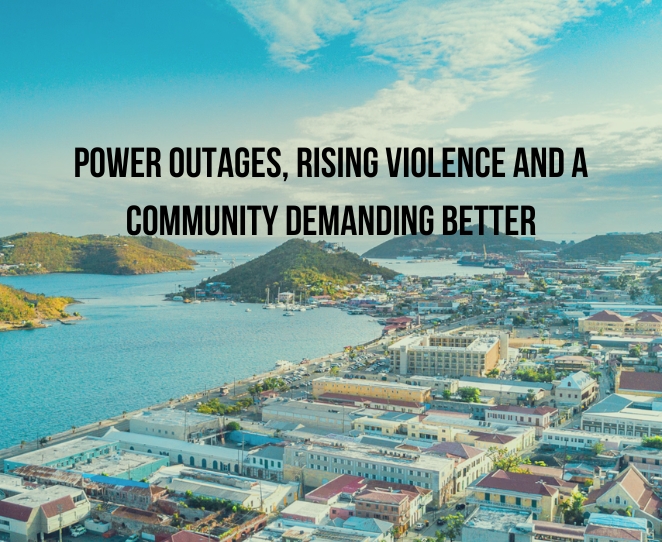
Residents gathered outside Government House on Thursday to voice growing frustration over two problems that have become impossible to ignore: unreliable electricity and the recent rise in deadly violence across the Virgin Islands.
The demonstration began at Emancipation Garden and continued to Government House, where residents carried signs, prayed for families affected by gun violence and called for greater accountability from territorial leaders.
Although the crowd was modest in size, the concerns raised affect thousands of people throughout St. Thomas, St. John and the wider territory.
Outages Are Disrupting Everyday Life
The continued instability of the Virgin Islands Water and Power Authority is no longer simply an inconvenience.
Repeated planned and unplanned outages are affecting homes, small businesses, schools, government offices and some of the territory's most vulnerable residents. Families are losing groceries they can barely afford to replace. Businesses are losing operating hours, equipment and revenue. Elderly residents and people with medical needs are being forced to navigate outages without knowing when service will return.
The disruption became especially clear Thursday when an outage reportedly interrupted business at the Legislature after its standby generator overheated.
When the government itself cannot reliably continue operating during a power interruption, residents are right to ask how ordinary households and small businesses are expected to manage.
Gregory P. Smith understands these concerns from the perspective of someone who has spent years operating a business in the Virgin Islands and employing local residents. Every unexpected closure, damaged appliance or lost workday creates another expense in a territory where nearly everything already costs more.
For a small business, an outage is not just a dark building. It can mean spoiled inventory, missed sales, employees sent home and customers who may not return that day. For a working family, it can mean another grocery bill that was never part of the budget.
Residents deserve a utility system that recognizes the real human and economic cost of unreliable service.
Recent Violence Has Deepened Community Fears
The protest also came during a painful period of gun violence, including the killing of 15-year-old Tre'Vante Etienne and several additional shootings and deaths across the territory.
Before marching, demonstrators paused to remember the lives lost and the families now living with grief.
Their concern was not only about individual crimes. It was about the growing feeling that violence is becoming more visible while police resources and community confidence appear increasingly strained.
Police leadership has acknowledged staffing limitations and has urged residents to provide information that can help solve recent crimes. Community cooperation is essential, but residents also need to see a clear public-safety strategy that includes visible policing, modern investigative tools and meaningful prevention.
That prevention must begin before another young person becomes a victim or an offender.
Youth mentorship, after-school programs, job training, mental-health care, substance-abuse treatment and stronger partnerships among families, schools, businesses and community organizations must all be part of the response.
Public safety cannot depend entirely on what happens after a shooting. It must also address the conditions that allow hopelessness, untreated trauma and crime to grow.
These Problems Are Connected
The power crisis and public-safety concerns may appear to be separate issues, but they share a common thread: residents are losing confidence that essential public systems will work when they are needed.
Unreliable utilities hurt businesses and household finances. Economic instability creates additional pressure on families. Limited opportunities leave more young people vulnerable to dangerous influences. Weak communication and delayed action deepen public distrust.
These problems cannot be solved through slogans, political blame or another temporary patch.
They require honest leadership, clear priorities and measurable results.
Gregory believes government should tell residents what is being repaired, how much it will cost, who is responsible and when the work is expected to be completed. When deadlines are missed or systems fail, the public deserves more than another explanation. It deserves accountability and a corrective plan.
A Better Way Forward
The Virgin Islands have no shortage of resilient people. Residents rebuild after storms, support their neighbors through hardship and continue operating businesses under conditions that would be difficult anywhere else.
But resilience should never become an excuse for government failure.
People should not have to accept constant outages as normal. Parents should not have to fear that violence will claim another child. Businesses should not have to purchase their own backup infrastructure simply to provide basic service.
The territory needs dependable utilities, stronger emergency readiness, focused crime prevention and a government willing to measure itself by results.
These are not partisan concerns. They are everyday concerns shared by families, workers, retirees and business owners throughout the district.
Solving them will require government agencies, law enforcement, businesses and residents to work together with greater urgency and transparency.
We can demand better without turning against one another.
We can build safer communities, more reliable infrastructure and a government that earns public trust.
We can do it better together.